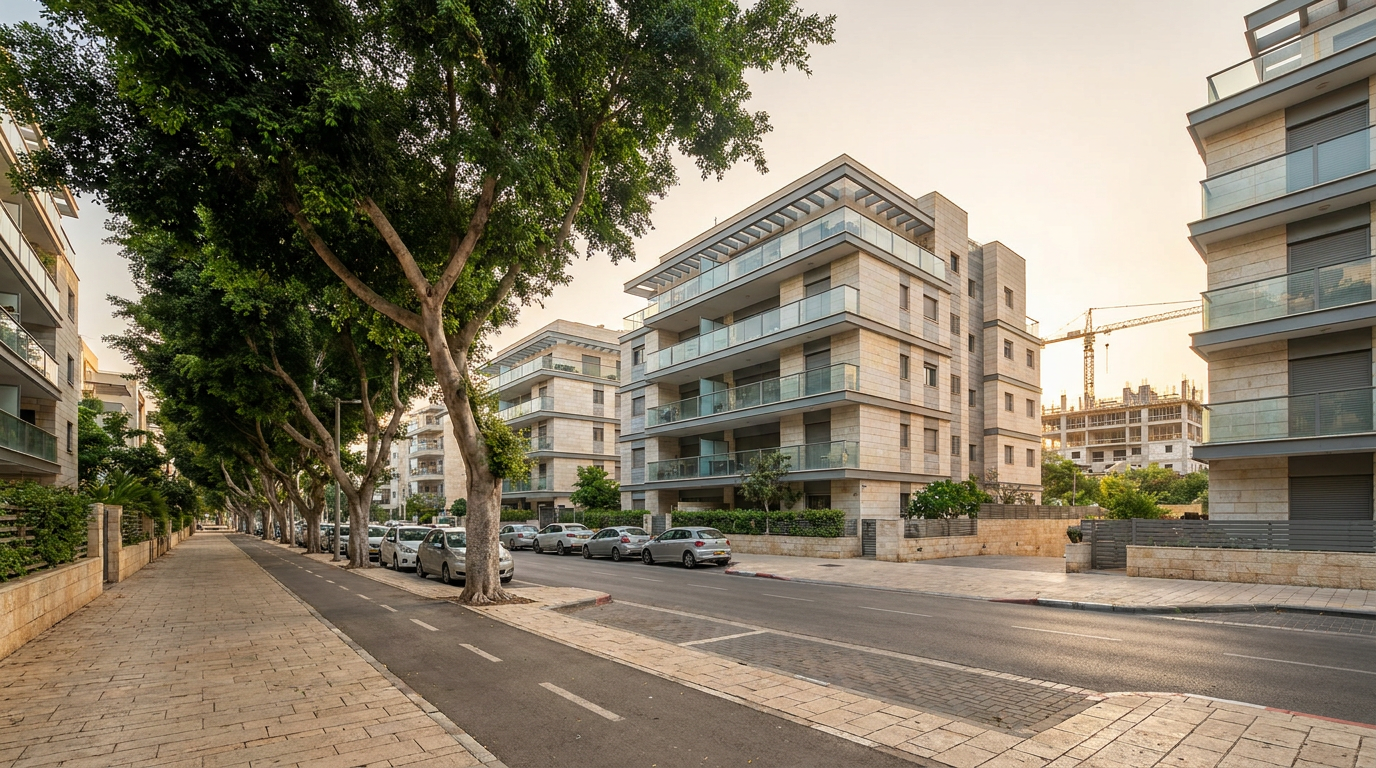
Raanana aims for 135,000 inhabitants: what the new master plan prepares
Raanana is one of the most sought-after residential cities in the Sharon region, north of Tel Aviv. Its municipality has just launched the update of its master plan, the document that will determine for decades where and how the city can grow. Just a few kilometers away, one of the largest projects in the center of the country, Taas HaSharon, is also back on the agenda. Two topics to watch for buyers abroad as well as for Israelis already living in Israel.
Raanana: Heading Toward 135,000 Residents
According to Nadlan Center, on October 6, 2026, Raanana is launching a revision of its general master plan, which was approved in 2016. The reasons cited: population growth, housing needs, progress of the metro, national policy to increase density around transport hubs, and adaptation to climate.
| Indicator | Value |
|---|---|
| Population according to the municipality | about 100,000 |
| Population according to the CBS | about 85,000 |
| Population target | 130,000 to 135,000 |
| Potential additional housing units | about 12,000 |
| Maximum height in the old center | 8 floors |
| Planned height on the Ahuza axis | 13 to 15 floors |
| First public meeting | October 14, 2026 |
A Low Center, Denser Outskirts
The mayor outlines three directions. In the old center, renewal would involve demolition and reconstruction, as older buildings no longer meet seismic standards; simple reinforcement has not been allowed for several years. Where towers of 30 floors were once considered, the mayor now allows up to 8 floors.
On the Ahuza axis, buildings of 13 to 15 floors are planned to make projects viable, with the aim of turning it into an employment and commercial hub, which the mayor hopes will be served by the tramway. Finally, the city's edges would see higher density, with no fixed height limit. The mayor also mentions three-room apartments for young people.
A Plan Still Open
Nothing is set in stone. Public consultation begins on October 14 with a public meeting, followed by working groups and online questionnaires. A master plan does not grant any permits: it frames the detailed plans that will follow over many years.
Taas HaSharon: 22,700 Housing Units Still on Hold
At the Sharon region level, one of the most significant cases remains Taas HaSharon, the former military industries site. According to Nadlan Center, on October 7, the joint district committee will meet on October 13, 2026, for the first time in about a year and a half, to discuss the environmental conditions of the project.
| Item | Value |
|---|---|
| Area | about 7,430 dunams |
| Municipalities involved | Ramat HaSharon, Hod HaSharon, Herzliya, Drom HaSharon |
| Planned housing units | about 22,700 |
| Employment | about 125,000 m² |
| Public buildings | about 175,000 m² |
| Plan approval | 2018 |
The site is heavily polluted, a legacy of years of industrial and military activity. In June 2024, the Supreme Court suspended the works and made permits conditional on a soil study and environmental assessment. In June 2026, the district appeals committee ordered the issuance of permits that had been blocked by a municipality. The October meeting is expected to clarify the sequence between remediation and permits. We cover this topic further in our article on contaminated soils and required checks.
What This Means for the Sharon Market
New supply in the Sharon thus depends on slow-moving files. In Herzliya, according to the summary of roof agreements published by Globes, a deal for 22,006 housing units signed in 2025 has not yet led to any marketing. In this context, already authorized projects and urban renewal concentrate the truly available supply.
Another signal this week: the Land Supervision Authority cited Kfar Saba and Ramat HaSharon among 17 local commissions that have not updated their mandatory register of building violations. For a buyer, this is a reminder: a property's compliance with the permit must be checked on a case-by-case basis.
Buying in Raanana: The Method
For buyers from abroad, Raanana offers a sought-after family environment, which is reflected in property prices. Compare with neighboring cities using our city budget simulator. For Israelis already living in Israel, the question is often whether to buy in an older central building that may be redeveloped: the upcoming 8-story limit will impact the balance of these projects.
Some key tips:
1. Do not pay today for building rights that are not included in any approved plan.
2. Treat the metro as a bonus, not a certainty: see our article on the Gush Dan metro.
3. Calculate the full cost: 18% VAT is included in the price of new properties, closing costs range from 10 to 13%, purchase tax (Mas Rechisha) to be checked according to your profile.
4. Surround yourself with three experts: lawyer · broker · architect. The lawyer checks plans and permits, the broker arranges financing, the architect assesses the real potential of the building.
Visit the Raanana page. IsraelStart lists 300+ new projects across Israel: request a personalized assessment, with no obligation.
Sources
- Nadlan Center — Raanana: the master plan update has begun (10/06/2026)
- Nadlan Center — Taas HaSharon: the plan returns to the planners (10/07/2026)
- Globes — Roof Agreements: the review (10/06/2026)
- Nadlan Center — Building violations: 17 local commissions behind schedule (10/04/2026)
Sources
- Source 1
- Source 2
- Source 3
- Source 4