New Build Property in Matan: Developments & Areas 2026
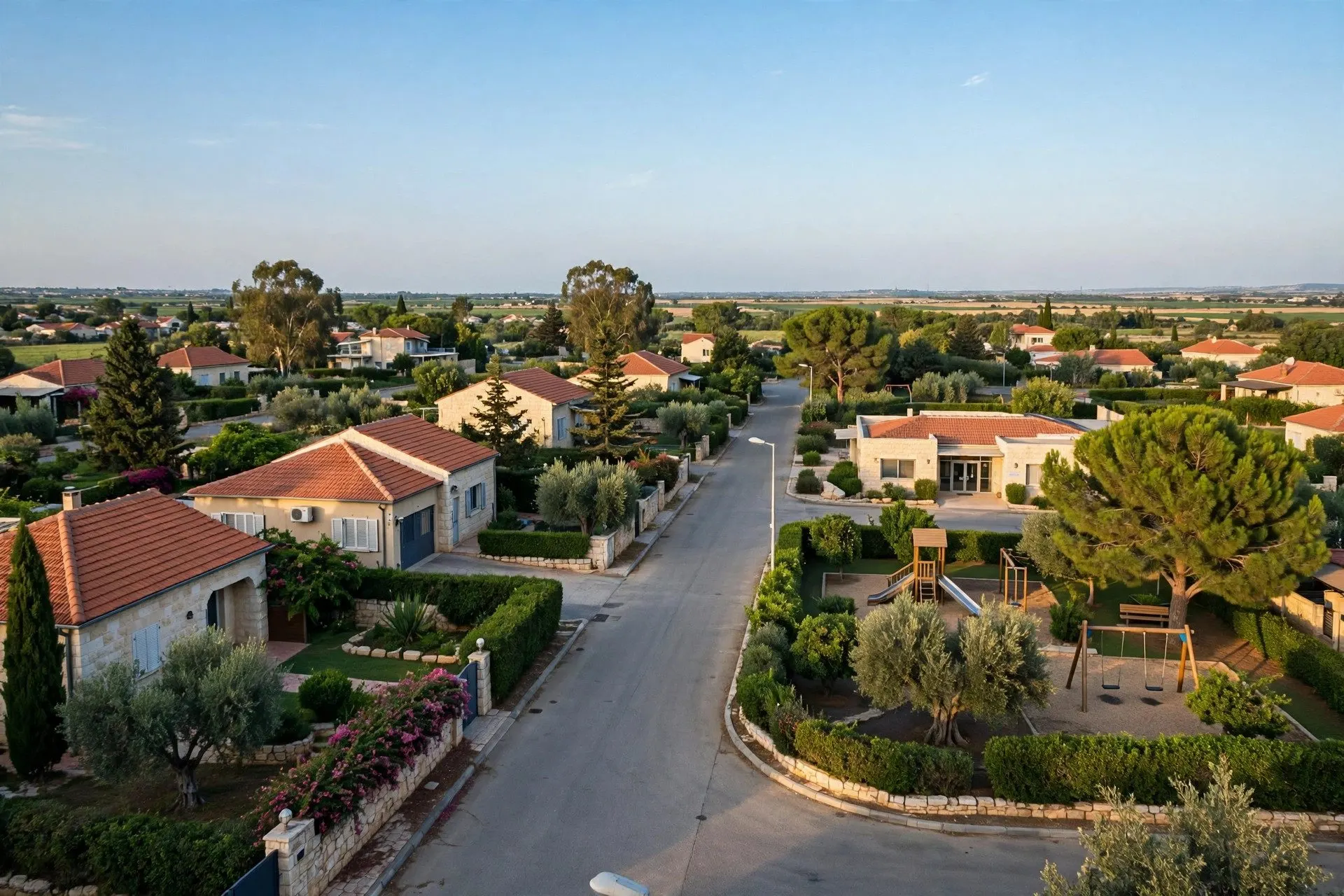
Matan is a community settlement in the Sharon, east of Kfar Saba, between the localities of Yarhiv and Nirit. Founded in 1993 as part of the Seven Stars Plan, it falls under the Drom HaSharon Regional Council and has 3,630 residents according to the Central Bureau of Statistics (CBS, 2021). Its name, meaning 'gift' in Hebrew, comes from the Book of Proverbs. Matan appeals to families looking for a detached house with a garden, in a green and quiet setting, about twenty kilometres from Tel Aviv.
Population: 3,630
Why invest in Matan
Matan — Hebrew for 'gift' — takes its name from a verse in the Book of Proverbs: 'A man's gift maketh room for him, and bringeth him before great men' (Proverbs 18:16). The community was founded in 1993 as part of the Seven Stars Plan, launched by Housing Minister Ariel Sharon to strengthen Jewish communities along the Green Line. It is therefore a recent, planned creation as a family residential community: no old centre and no historic neighbourhoods, but residential streets laid out in one piece, detached houses and green spaces. In 2021, Matan had 3,630 residents according to the CBS, an almost entirely Jewish population (99.1% Jewish according to CBS 2021 data relayed by citypopulation.de). Its well-known residents include Yuval Diskin, former director of the Shin Bet. The community falls under the Drom HaSharon Regional Council, whose headquarters are on Highway 40 near Neve Yarak, and lies in the Central District, Petah Tikva subdistrict. Its small size — about half a square kilometre — makes it one of the Sharon's most close-knit communities: an active community centre on Hadar Street, neighbourhood associations and a social life organised around families.
Living in Matan means living in a residential village where everything is done on foot or by bicycle, and where the car takes over for the rest. Detached houses dominate, often with a garden, on quiet, tree-lined streets; children attend the regional council's schools and those of neighbouring towns, and the community centre on Hadar Street offers activities and meetings. Everyday shopping is in Kfar Saba and Hod HaSharon, a few minutes away by car, with their shopping centres, markets and services. Greenery is everywhere: Matan is surrounded by the Sharon's fields and open spaces, between Yarhiv to the north and Nirit to the south, and walks and bike rides start at the front door. The setting attracts families who work in Gush Dan but refuse the density of the big cities: the quiet of a yishuv and, ten minutes away, the schools, stations and shops of Kfar Saba and Hod HaSharon. Tel Aviv is about twenty kilometres away, roughly half an hour's drive depending on traffic.
Buying in Matan means buying a detached house in a small market, not an apartment in a block. IsraelStart lists no new development in the locality: this page is therefore a guide, and the homes to compare are found in the resale market — detached houses with gardens, sometimes extended or renovated — as well as in the yishuv's rare new buildings. Before any decision, no price per square metre is given here: no verified public transactional source was found for Matan, and a house's price must be judged case by case, comparing recent sales in the yishuv and in neighbouring towns such as Kfar Saba, Hod HaSharon, Rosh HaAyin or Petah Tikva. IsraelStart's personalised search covers new and resale alike, including homes outside the catalogue, with a lawyer and a broker. Purchase tax (Mas Rechisha) depends on the buyer's situation — first-time buyer, single home, investor or non-resident — and its brackets are subject to professional review: the tax guide and the taxes-and-fees simulator let you cost each case before signing, with no figures quoted here. The financing simulator then helps frame the budget and the mortgage (mashkanta), and the city-budget simulator compares the cost of living and housing between Matan and neighbouring towns. For a diaspora buyer, the buying guide and the page dedicated to aliyah complete this community guide.
- Buy a house, not an apartment: Matan means detached houses with gardens: the purchase turns on the plot, the aspect and the condition of the building.
- Choose the yishuv for its setting: Quiet streets, greenery, community life: the living environment is the home's first value, even before its size.
- Compare with neighbouring towns: Kfar Saba, Hod HaSharon, Rosh HaAyin and Petah Tikva provide the price benchmarks: compare homes one by one before signing.
- Check every home with a lawyer: Title deed at the Tabu, building permits, easements: the lawyer checks every house, especially older ones.
- Buy from abroad with support: Buying remotely, aliyah, financing: IsraelStart supports overseas buyers from search to signing.
Key advantages
- A family-friendly, green yishuv: Detached houses, gardens, quiet streets and green spaces: Matan is designed for families, with 3,630 residents.
- An active community life: Community centre on Hadar Street, associations and neighbourhood life: the small yishuv lives together, which attracts families.
- The Sharon within reach: Kfar Saba and Hod HaSharon a few minutes away, Tel Aviv about twenty kilometres: the Sharon countryside without isolation.
- A young, planned community: Founded in 1993, Matan has no old centre and no derelict land: uniform residential streets, recent houses, a well-kept setting.
- Quiet without remoteness: Fields and open spaces around the yishuv, yet the stations, schools and shops of neighbouring towns ten minutes away.
Infrastructure & Transport
- Highway 6 very close: Highway 6, the north-south motorway, passes west of the yishuv and links Matan to Haifa as well as to Tel Aviv and the south of the country.
- Kfar Saba and Hod HaSharon stations: Kfar Saba–Nordau and Hod HaSharon–Sokolov stations, about ten minutes away by car, open the rail network to Tel Aviv and Haifa.
- Highways 5 and 55: Highway 5 to the south and Highway 55 serve the Sharon towns and the employment areas of Gush Dan.
- Community centre and schools: Community centre on Hadar Street, kindergartens on site, and the regional council's schools and those of neighbouring towns for older children.
Investment profile
- Family primary residence: The typical profile is a family buying a detached house with a garden in a quiet yishuv, close to schools and Gush Dan jobs.
- Diaspora families: The setting — detached houses, community life, proximity to Tel Aviv — attracts families making aliyah who look for a first foothold outside the big cities.
- Cautious heritage investment: A small market, rare supply, family demand: no yield and no price rise can be guaranteed, and no figure is given here for lack of a transactional source.
Neighborhoods of Matan
Community heart
Northern sector
Southern sector
Eastern sector — towards Yarhiv and Nirit
Western sector — towards Kfar Saba
New build or resale in Matan
In Matan, you can compare the new developments listed in our catalogue or entrust us with the search for an existing property. The choice depends on your timeline, overall budget and target neighbourhood.
For resale, we define a brief with you — neighbourhood, number of rooms, mamad, lift, parking, outdoor space — then consult several sources and present an explained selection, with trade-offs and points to confirm.
Search in Matan Buying resale property: the guideFrequently asked questions about Matan
Is Matan a good place to buy a house?
Matan suits families looking for a detached house with a garden in a quiet Sharon yishuv, close to Kfar Saba and Tel Aviv. The market is small and supply is rare: compare each house with sales in the yishuv and in neighbouring towns, and work with a lawyer and a broker.
What are the areas of Matan?
Matan is a small yishuv with no official neighbourhoods: it has a community heart, around the community centre on Hadar Street, and residential sectors to the north, south, east towards Yarhiv and Nirit, and west towards Kfar Saba.
Are there new developments in Matan?
No: IsraelStart lists no new development in the locality, and this page is a guide. The offer is in resale homes and in the yishuv's rare new buildings; the personalised search also covers homes outside the catalogue.
How do you get to Matan?
By car on nearby Highway 6, or on the Sharon roads from Kfar Saba and Hod HaSharon. By train from Kfar Saba–Nordau and Hod HaSharon–Sokolov stations, about ten minutes away by car.
Can I buy in Matan from abroad?
Yes. IsraelStart supports overseas buyers, including as part of aliyah: personalised search, viewings, lawyer, broker and financing. Purchase tax depends on the buyer's situation: the tax guide and the taxes-and-fees simulator cost each case.
Similar cities
Discover other nearby cities or in the same price range.