Israel Real Estate Tax Non-Resident 2026: Everything to Know Before Buying
Overview of the Israeli Real Estate Tax System
The Israeli real estate tax system is structured around five main taxes that apply at different stages of your investment’s lifecycle: at purchase, during ownership, and upon resale. Understanding each of these taxes is essential for properly budgeting your project and optimizing your net return.
For a non-resident buyer, the total tax burden is higher than for an Israeli resident, mainly due to the increased Mas Rechisha. However, several optimization mechanisms exist, notably through the tax treaty with your country of residence and the choice of the rental income tax regime.
Mas Rechisha: Purchase Tax
Mas Rechisha is the acquisition tax, payable within 50 days of signing. For non-residents, the rate is 8% on the full price up to approximately 6 million shekels, then 10% above that. This is the heaviest tax burden. For a property priced at 2 million shekels, expect to pay 160,000₪. Details of the tax brackets and calculation examples are available in our dedicated guide to Mas Rechisha.
Mas Shevach: Capital Gains Tax
When reselling your property, the capital gain is subject to Mas Shevach (real estate capital gains tax). The base rate is 25% on the net capital gain, calculated as the difference between the sale price and the indexed purchase price. Holding period allowances gradually reduce the taxable amount. A full exemption is possible for the sale of your sole residence (Dira Yehida) under certain conditions, but this exemption is rarely applicable to non-residents.
Deductible expenses from the capital gain include: acquisition costs (Mas Rechisha paid at purchase, attorney fees), documented improvement works, mashkanta interest (under certain conditions), and sales commissions.
Rental Income: 3 Taxation Regimes
If you rent out your property, three regimes are available to you:
The flat-rate regime at 10% of gross income is the simplest. No expenses are deductible, and no annual declaration is required in Israel. You simply pay 10% of the gross rent received, in semi-annual payments. This is the choice of most non-residents with a single rental property.
The 15% regime on net income allows you to deduct operating expenses—maintenance, property management, insurance, Arnona if paid by you—but not depreciation or mashkanta interest. This is attractive if your expenses exceed 33% of the gross rent.
The progressive regime incorporates rental income into the standard tax scale (10% to 50%). It allows deduction of all expenses, including property depreciation and mashkanta interest. Advantageous for large portfolios with high expenses, but complex to manage from abroad.
Arnona: The Annual Housing Tax
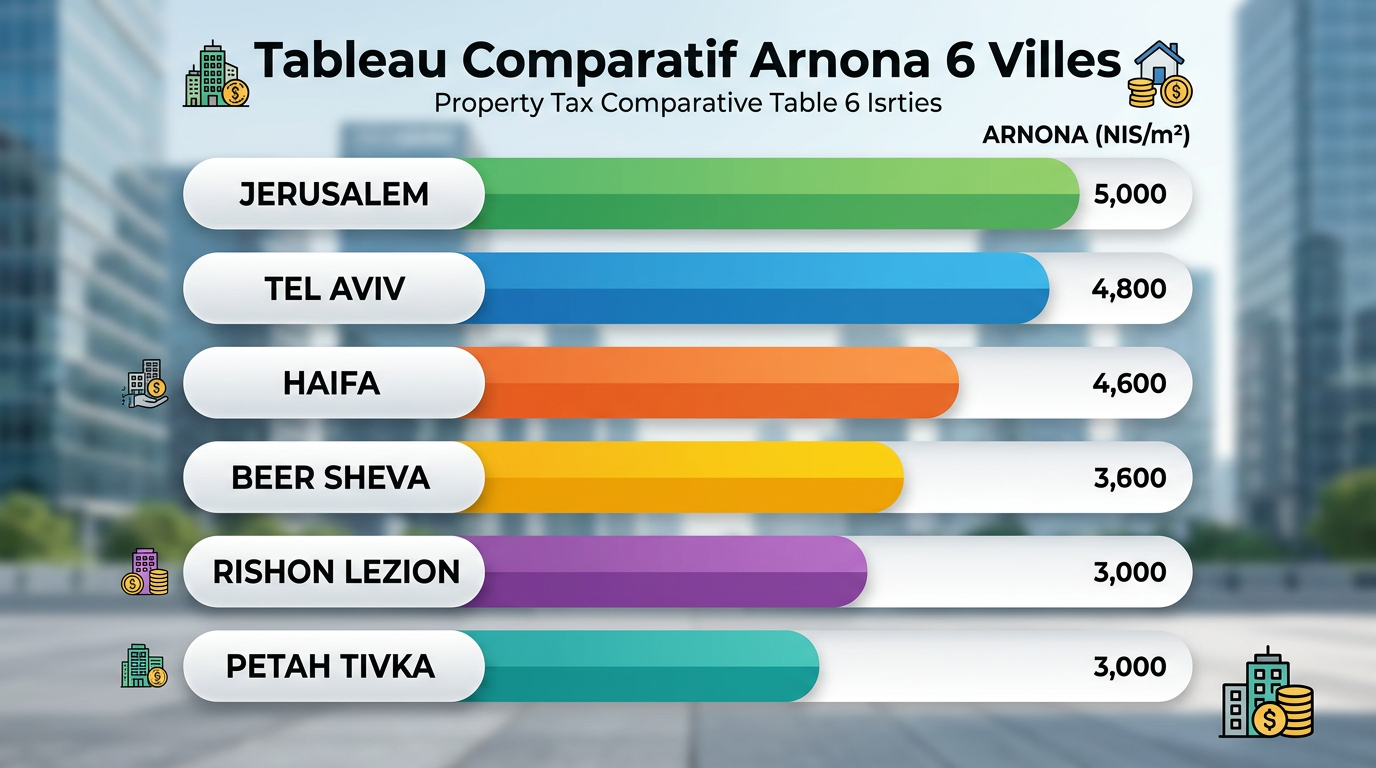
Arnona is the equivalent of the French housing tax. It is a yearly municipal tax, calculated based on the property's size and its geographic area. Rates vary significantly from one city to another: from 50₪/m²/year in outlying cities to 150₪/m²/year in Tel Aviv's premium neighborhoods.
For an 80m² apartment in Netanya, the annual Arnona is about 6,000₪ to 8,000₪. In Tel Aviv, it can reach 10,000₪ to 12,000₪. If the property is rented, Arnona is usually paid by the tenant (a standard clause in Israeli leases). If the property is vacant, the owner pays.
18% VAT on New Properties: How It Works
Israeli VAT (Ma'am) of 18% is included in the displayed price of new homes. The price you pay to the developer is tax included. Therefore, it is not an extra cost to budget separately. However, VAT applies to additional services: lawyer fees, Mashkanta brokerage, property management, customization works.
For resale properties sold between individuals, there is no VAT. VAT only applies to transactions involving a liable professional (developer, property trader).
Double Taxation Agreement
The tax treaty with your country of residence is the final key element. For French residents, the 1995 agreement provides tax credits that prevent double taxation on rental income and capital gains. See our dedicated guide to the France-Israel agreement for details on how it works.
Comparative Table: Resident vs Non-Resident
| Tax | Resident (1st property) | Non-resident |
|---|---|---|
| Mas Rechisha | 0% to 10% (progressive) | 8% to 10% |
| Mas Shevach | 25% (possible exemption) | 25% (no Dira exemption) |
| Rental income | 10%, 15% or progressive | 10%, 15% or progressive |
| Arnona | Standard | Standard |
| New VAT | Included in the price | Included in the price |
For a profitable rental investment, tax optimization is just as important as choosing the right city. IsraelStart connects you with tax experts who master both systems to maximize your net returns.
IsraelStart's support includes this aspect in its turnkey offer.
Need personalized support?
An IsraelStart expert will call you within 24h with a personalized analysis of your project.