Arnona: Property Tax in Israel | Complete Guide
Arnona: What Is It?
Arnona (ארנונה) is the Israeli municipal tax, equivalent to the combined French residence and property taxes. It is the main source of income for Israeli municipalities and funds local services: roads, lighting, public gardens, waste removal, and social services.
Every owner or tenant occupying a property in Israel is liable for Arnona. For rental properties, the tenant usually pays the Arnona (a standard clause in Israeli lease agreements). For vacant properties or secondary residences, the owner is responsible. This expense should be included when calculating the profitability of your real estate investment.
Arnona Rates 2026 by City (Comparison Table)
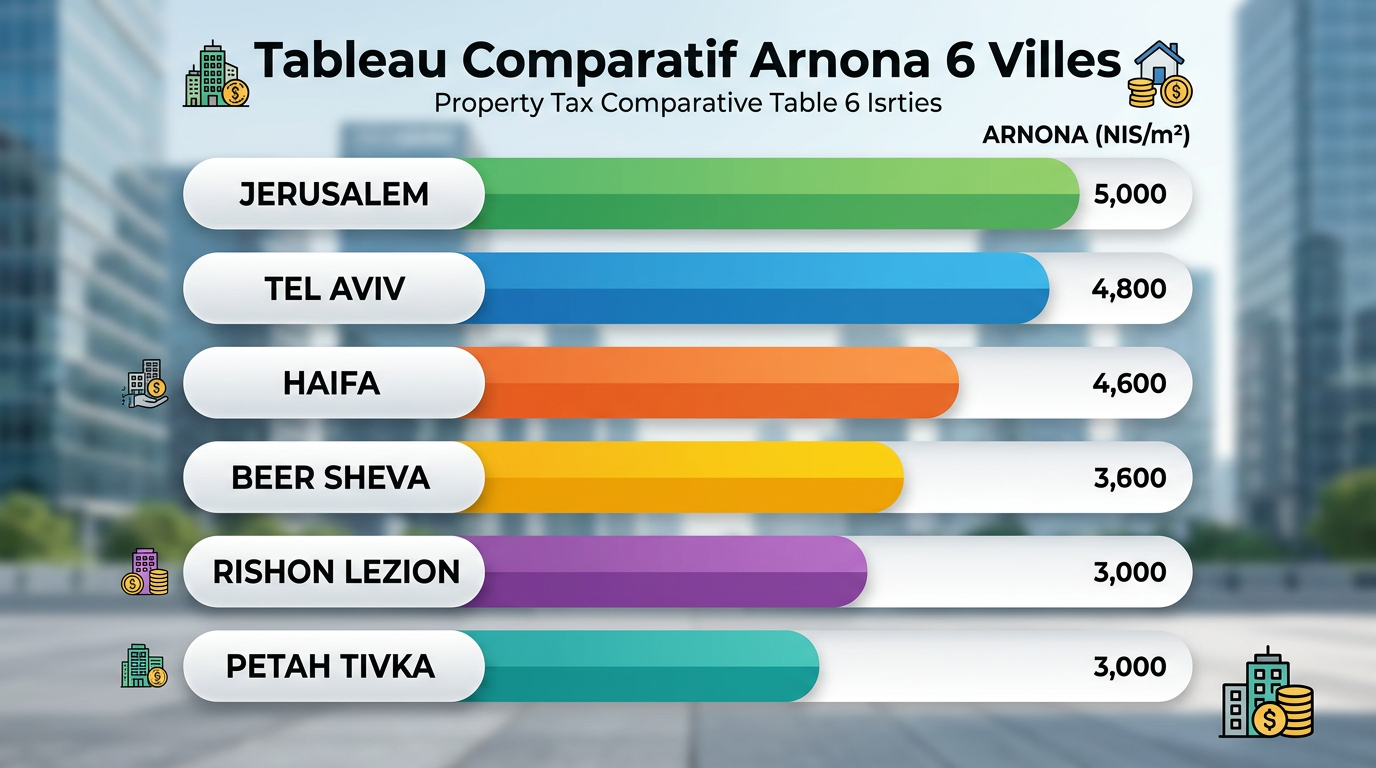
Arnona rates vary significantly from one city to another, and even between neighborhoods within the same city. Each municipality sets its own rates, classified by zones and by type of use (residential, commercial, industrial).
| City | Average Residential Rate (₪/m²/year) | Example 80m² (₪/year) |
|---|---|---|
| Tel Aviv | 120 – 160 | 9,600 – 12,800 |
| Jérusalem | 80 – 120 | 6,400 – 9,600 |
| Netanya | 70 – 100 | 5,600 – 8,000 |
| Haïfa | 65 – 95 | 5,200 – 7,600 |
| Beer Sheva | 50 – 75 | 4,000 – 6,000 |
| Herzliya | 100 – 140 | 8,000 – 11,200 |
These rates are indicative and based on standard residential areas. Premium neighborhoods (seaside, historic center) can be 30% to 50% more expensive. Peripheral or developing areas often benefit from reduced rates.
How is Arnona calculated?
The calculation of Arnona is based on three parameters: the property's area in m² (according to the cadastral record), the tariff zone defined by the municipality, and the type of use (residential, commercial, office). The formula is simple: area × zone rate per m² = annual Arnona.
The area taken into account is the gross registered area, including interior walls but excluding common areas (corridors, stairwells). Enclosed balconies are included, while open balconies are partially counted (about 50%). Parking spaces and storage rooms have their own rates, generally lower than the residential rate.
It is possible to challenge the zoning classification or the recorded area if you believe there is an error. Your lawyer or a certified surveyor can assist you in this process.
Arnona Discounts: Olim, Students, Seniors
Several categories of residents are eligible for Arnona discounts: Olim Hadashim (new immigrants) receive a 90% discount in the first year, then a decreasing rate over the next 12 months, for a total of 2 years of reduction. Full-time students benefit from an 80% discount on properties under 100m². Seniors over 65 years old, subject to income conditions, can obtain a reduction ranging from 25% to 100%. Recipients of social benefits (Bitouach Leoumi) receive a discount of 70% to 100%.
These discounts mainly apply to residents. For non-residents who own a vacant property, no specific reduction is usually applicable. This is another reason to rent out your property: not only do you receive rental income, but the Arnona is paid by the tenant.
Arnona for Non-Residents
As a non-resident property owner in Israel, you are liable for Arnona if the property is vacant or if the lease specifies that Arnona is your responsibility (which is rare). If the property is rented with the standard clause transferring Arnona to the tenant, you have nothing to pay.
If the property is vacant (secondary residence or awaiting rental), you pay Arnona at the standard residential rate, with no discount. Some municipalities even apply a higher rate for long-term vacant properties to encourage owners to rent them out.
Payment of Arnona can be managed by your property manager or your lawyer as part of a management mandate.
Payment: Monthly, Bimonthly, or Annual
Arnona can be paid in three ways: in two semi-annual installments (default option), by automatic monthly debits (Horaat Keva), or in a single annual payment (sometimes with a 1% to 2% discount for early payment).
Payment can be made via the municipality's website, by bank debit, or at a municipal office. For non-resident owners, setting up an automatic debit is highly recommended to avoid any delays and associated penalties.
Comparison with French Property Tax
For comparison, the Israeli Arnona is generally higher than the former French residence tax (before its gradual phase-out), but comparable to or lower than the French property tax in major cities. For an 80m² apartment: in Paris, the property tax is about €1,500 to €2,500 per year. In Tel Aviv, Arnona is about €2,400 to €3,200 per year. In Netanya, Arnona is about €1,400 to €2,000.
Arnona includes services that the French property tax does not directly cover (notably waste collection), which puts the difference into perspective. For a detailed analysis of costs by city, see our city comparison.
IsraelStart offers turnkey support for buyers from abroad. Every step is managed by our team in your language.
Need personalized support?
An IsraelStart expert will call you within 24h with a personalized analysis of your project.