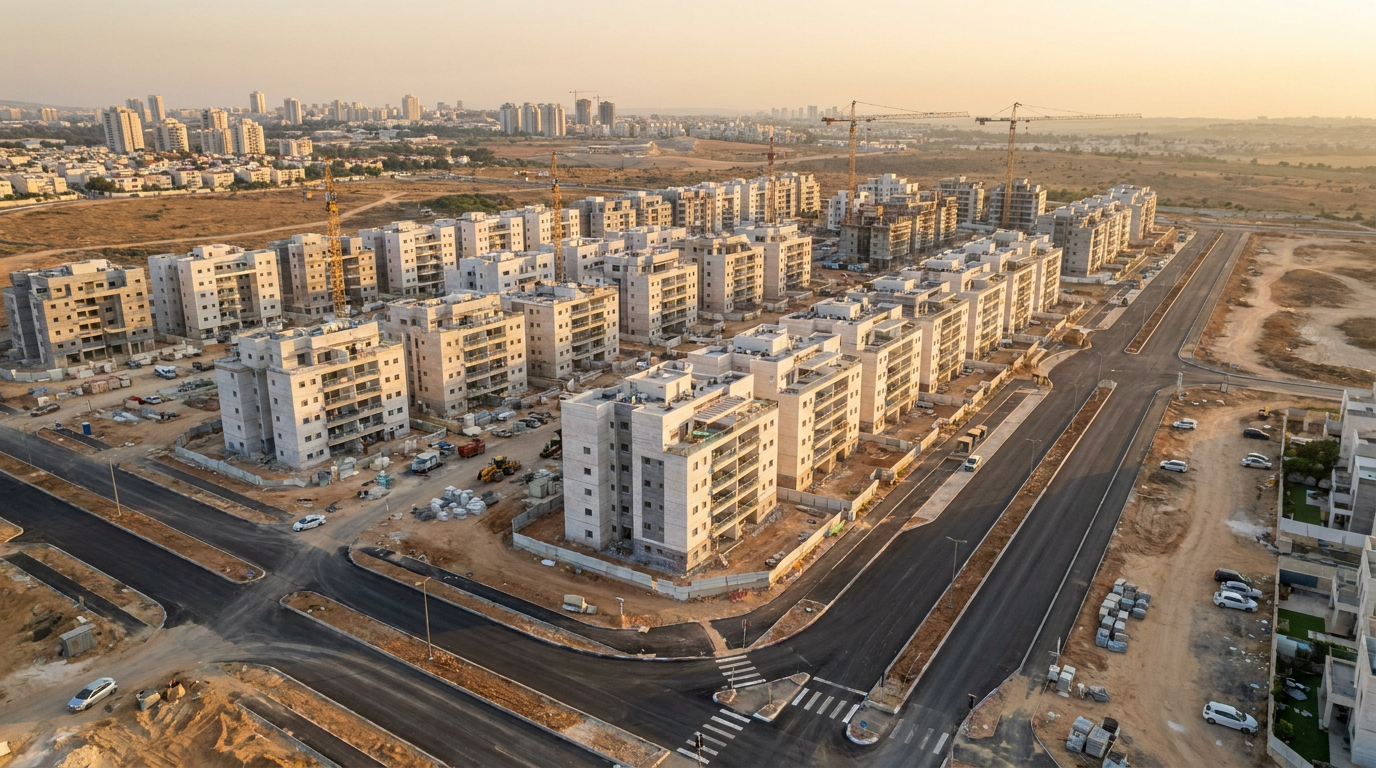
Roof agreements in Israel: 591,631 homes promised, 43% marketed
For thirteen years, the Israeli government has been signing so-called "roof agreements" (heskem gag) with municipalities, intended to speed up housing construction. A report published by Globes on October 6, 2026, based on the government's financial accounts, shows that less than half of the promised homes have actually reached the market. For buyers from abroad as well as Israelis already living in Israel, this report helps distinguish between cities where new neighborhoods are truly being built and those where they remain only on paper.
How does a "roof agreement" work?
The principle is an exchange. The municipality agrees to accommodate a large number of housing units within its territory. In return, the State finances infrastructure, public buildings, upgrades of old neighborhoods, and the removal of planning obstacles. The stated goal: to build as many homes as possible to meet demand.
According to Globes, 46 agreements have been signed by the end of 2025: 26 with the Land Authority and 20 with the Ministry of Construction and Housing.
National Overview: 43% of Units Marketed
The agreements cover 591,631 housing units. Only 253,384 have been marketed, which is about 43% (the article title mentions around 44%).
| Indicator | Value |
|---|---|
| Agreements signed until end of 2025 | 46 |
| Planned housing units | 591,631 |
| Marketed units | 253,384 (about 43%) |
| Rate, Israel Land Authority agreements | 44.75% |
| Rate, Ministry of Housing agreements | 39.27% |
| Cost of approved infrastructure | about ₪4.28B |
| Public buildings and old neighborhoods | about ₪11.53B |
In other words, the State plans to invest nearly ₪16B (estimates) for a still partial result. Yet, it continues to sign: Holon has just concluded its first agreement and, in July 2026, a first agreement was signed with a regional council.
City by City: Top Performers and Laggards
The differences are significant.
| City (year of agreement) | Marketing Rate | Units Marketed |
|---|---|---|
| Beit Shemesh | 108.1% | 15,597 |
| Kiryat Gat (2018) | 104.4% | 7,758 |
| Ofakim (2017) | 103.2% | 11,491 |
| Netivot (2017) | 98.8% | 14,819 |
| Tel Aviv, Sde Dov district | 94.9% | 9,316 |
| Ashkelon (2015) | 81.2% | 14,825 |
| Rishon LeZion (2014) | 55.1% | 10,284 |
| Haifa (2018) | 42.6% | 6,710 |
| Yavne (2016) | 28.3% | 4,300 |
| Afula (2016) | 28.2% | 3,349 |
| Ashdod (2017) | 14.95% | not specified |
| Tirat Carmel | 14.5% | not specified |
Source: State financial accounts, data published by Globes.
The South Succeeded, the Center Stalls
Southern cities and Ashkelon have marketed most of their initial agreements, which partly explains the abundance of new housing in the region. In contrast, Herzliya has marketed only 31.3% of its first agreement and nothing yet from its giant 2025 agreement, which covers 22,006 units. In Netivot, the second agreement, for about 17,000 units, has not started either.
What Makes the Difference
An urban governance specialist quoted by Globes emphasizes that success depends on the municipality's ability to negotiate, defend its priorities, and finance the operation of new neighborhoods over time. Where the agreement has worked, both population and construction have grown significantly.
What This Means for a Buyer
A roof agreement is not a delivery guarantee, but it is an indicator.
- In a city where everything has been marketed, new supply is plentiful: schools and roads follow, but competition between projects can affect short-term resale. This is also where negotiation is most open.
- In a city that is lagging behind, new supply remains scarce. Prices hold up better, but the timeline for future neighborhoods remains uncertain.
- In a city that just signed, like Holon with about 10,700 homes spread over eight plans and some ₪3.1 billion in announced investments, the effects will be measured over ten years or more. We detail this case in our article on the 2,084-unit project in Holon East.
This overview completes last week's signal: public land tenders dropped sharply in 2026. Between signed but unmarketed agreements and declining tenders, future new supply will depend more on urban renewal, as in Netanya.
How to Use This Assessment in Your Project
For a buyer from abroad, the commercialization rate helps sort cities before traveling: it shows where public facilities are likely to be delivered at the same time as the housing. For an Israeli already in Israel, it helps anticipate the evolution of their own neighborhood and future competition when reselling.
In both cases, a few key steps are essential:
1. Compare the available budget city by city with our city budget simulator.
2. Check the actual progress of the neighborhood: roads, schools, transportation—not just the model.
3. Calculate the total cost: 18% VAT included in the new property price, closing costs of 10 to 13%, and purchase tax (Mas Rechisha) to be confirmed based on your profile.
4. Have the permit, bank guarantees, and contract reviewed before signing anything.
These checks rely on three complementary experts: lawyer · broker · architect. The lawyer secures the contract and guarantees, the broker structures the financing, and the architect analyzes the plans and specifications.
The Essentials
Roof agreements have transformed several cities, especially in the South, but more than half of the promised homes are still pending. For context on this figure, read our weekly review. IsraelStart lists 300+ new projects across Israel: browse the catalogue and request a personalized review, with no obligation.
Sources
- Globes — Roof Agreements: nearly 600,000 housing units planned, less than half marketed (10/06/2026)
- Globes — Israel Land Authority Tenders (09/28/2026)
Sources
- Source 1
- Source 2