Staggered Payments for Off-Plan Purchases in Israel: Complete Guide
The Principle of Payment Scheduling in Israel
One of the main advantages of buying off-plan (VEFA) in Israel is the scheduling of payments throughout the construction period. Unlike purchasing an existing property, where the total price is paid in one go at signing, buying off-plan allows you to spread payments over 18 to 36 months, in line with the progress of the building site.
This mechanism is particularly beneficial for buyers from abroad: it gives you time to gradually transfer funds, set up the mashkanta for the final balance, and plan your cash flow without pressure.
The payment schedule is governed by the sales contract (Heskem Ekar), which precisely sets the dates and amounts of each installment. Every payment is protected by a bank guarantee (Havtachat Milvia) issued by the developer, in accordance with Israeli law on apartment sales.
Typical Timeline: From Contract to Delivery
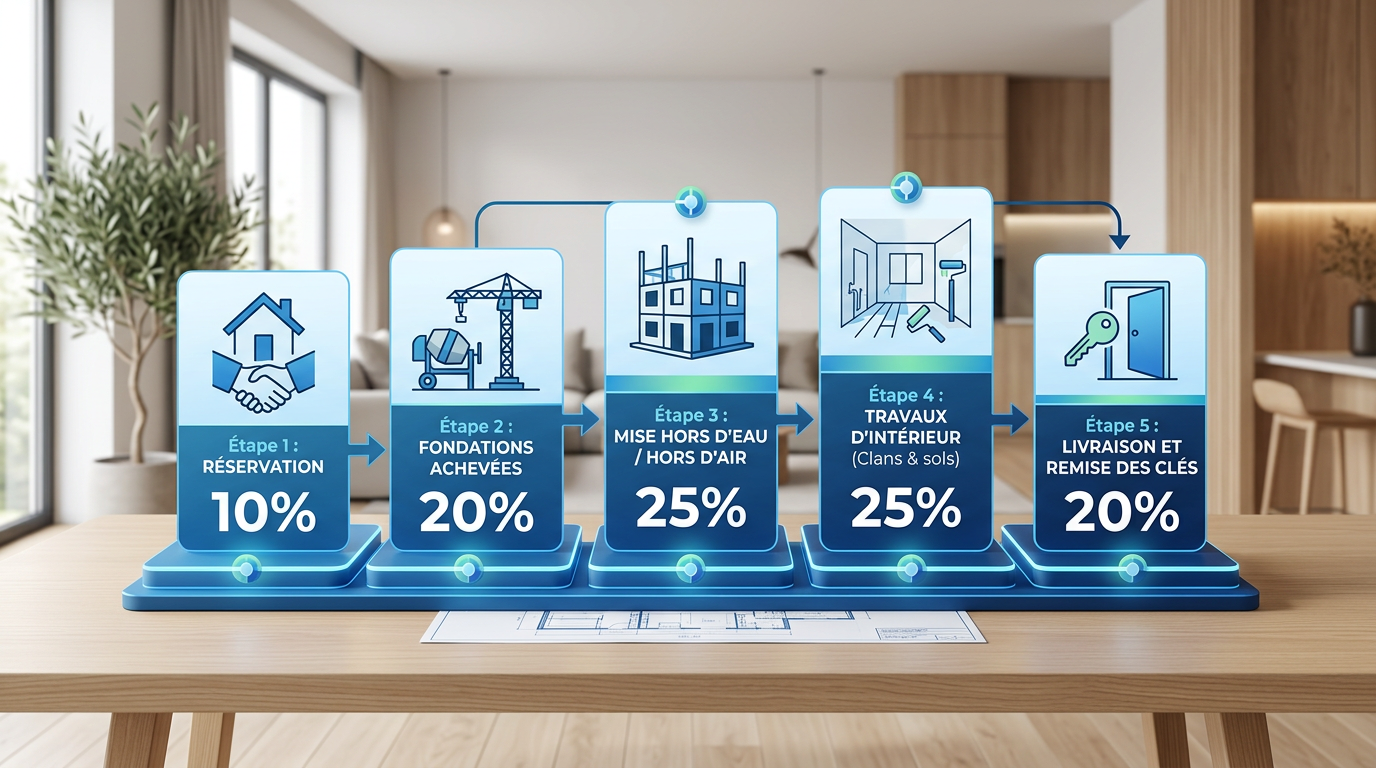
A standard payment schedule for a new development in Israel follows this structure:
| Step | % of Price | Timing | Typical Delay |
|---|---|---|---|
| Contract Signing | 10% | Day 0 | Immediate |
| Foundations Completed | 15% | Month 6-8 | +6-8 months |
| Structural Work (apartment floor) | 15% | Month 12-16 | +12-16 months |
| Interior Partitioning | 15% | Month 18-24 | +18-24 months |
| Delivery (handover of keys) | 45% | Month 24-36 | +24-36 months |
This 10/15/15/15/45 schedule is the most common, but it is not universal. Each developer offers their own payment plan, which can vary significantly. Some premium projects require 20% at signing, while others offer more gradual schedules with 6 or 7 payments.
Standard Payment Stages (10/15/15/15/45)
Payment 1 — Signing (10%): paid within 7 to 14 days after signing the Heskem Ekar. This first payment triggers mutual commitment and the issuance of the bank guarantee by the developer.
Payment 2 — Foundations (15%): due when the building's foundations are completed and the developer provides the corresponding certificate. Your lawyer checks the progress before approving the payment.
Payment 3 — Structural Work (15%): due when the concrete structure reaches the floor of your apartment. This is often when the property starts to take physical shape.
Payment 4 — Partitioning (15%): due after the interior partitioning, plumbing, and electrical work of your apartment are completed. At this stage, the room layout becomes visible.
Payment 5 — Delivery (45%): the balance is paid upon key handover, after the final inspection of the property. This last payment is often financed by the mashkanta, which is released upon actual delivery.
Negotiating Your Payment Schedule with the Developer
The payment schedule proposed by the developer is a key negotiation point. Your lawyer can secure favorable adjustments for you, such as: reducing the initial payment from 10% to 7% to ease your initial cash flow, spreading out payments more gradually with additional intermediate installments, postponing the balance payment to 30 days after actual delivery to give you time to finalize the mashkanta, and removing or reducing Madad indexation on intermediate payments.
The room for negotiation depends on demand for the project: a highly sought-after project with limited availability offers little flexibility, while a newly launched development provides more leeway.
Payment Indexation: Watch Out for the Madad
The Madad (Construction Price Index, published by Israel's Central Bureau of Statistics) is a common indexation mechanism in off-plan purchase contracts. In practice, future payments are adjusted up or down according to changes in the Madad between the signing date and each payment date.
During periods of sustained inflation, Madad indexation can represent a significant extra cost of 3% to 8% of the total price over a 3-year construction cycle. Conversely, in periods of deflation or stability, the impact is minimal.
Your lawyer should check the indexation clauses in the contract: does the Madad apply to all payments or only to intermediate ones? Is there a cap on indexation? Is the final payment (45%) indexed? The answers to these questions directly affect your final budget.
Simulate Your Personalized Payment Schedule
Our payment schedule simulator allows you to visualize your personalized payment timeline. Enter the property price, the type of schedule (10/15/15/15/45 or custom), the estimated construction start date, and the expected Madad indexation rate. The simulator generates a table with the dates and amounts of each installment, including indexation.
Havtachat Milvia Bank Guarantee Protection
The Havtachat Milvia (bank guarantee) is a mandatory legal protection for any off-plan purchase in Israel. The developer must provide the buyer with a bank guarantee for each payment made, issued by a recognized Israeli bank.
This guarantee ensures that if the developer goes bankrupt, fails to deliver the property, or does not comply with the contract, the buyer can recover all amounts paid from the guaranteeing bank. It is a strong protection that secures your investment throughout the construction process. Your lawyer systematically checks the receipt of each guarantee before validating payments.
IsraelStart's support includes this aspect in its turnkey offer.
Need personalized support?
An IsraelStart expert will call you within 24h with a personalized analysis of your project.