New Build Property in Pardes Hanna-Karkur: Developments & Areas 2026
Pardes Hanna-Karkur is a local council in the Haifa District, in the Hadera sub-district, between Tel Aviv and Haifa. With 46,601 residents at the end of 2024, it is the largest local council in Israel by population, covering 22.6 square kilometres, and it has never held city status. This guide brings together everything you need to know before buying in Pardes Hanna-Karkur: the neighbourhoods, transport, schools, shops and procedures, with no invented prices and no promised development. Where a price can be sourced, it is quoted with its source; otherwise, the guide points to the personalised property search and the simulators.
Population: 46,601
Why invest in Pardes Hanna-Karkur
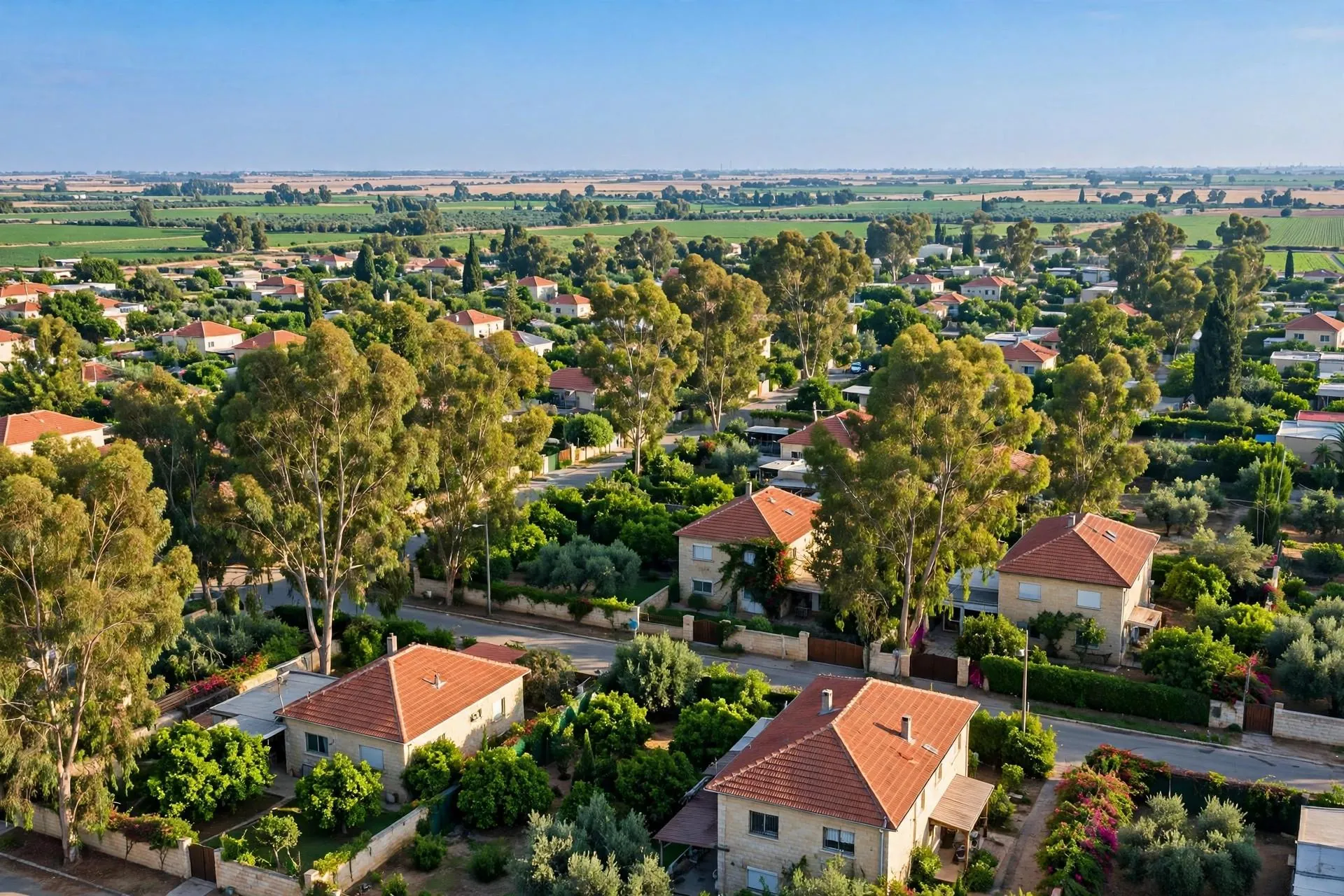
Pardes Hanna-Karkur was born from the merger of two localities: Pardes Hanna, a moshava founded in 1929 and named after Hanna Primrose, née de Rothschild, and Karkur, founded in 1913. The two historic centres survive today, and the locality long lived from its citrus groves before becoming a sought-after residential suburb. On the property market, Pardes Hanna-Karkur stands out first through its profile: the largest local council in Israel, a bohemian village between Tel Aviv and Haifa. The Pardes Hanna-Karkur market rests mainly on houses with gardens and villas in the two historic centres, and no price per square metre is shown on this page, as no sourced price is available for the locality at the time of writing. From Pardes Hanna centre to Karkur centre, through the northern, southern, school and green neighbourhoods, prices vary greatly depending on the neighbourhood, the floor, the condition of the home and whether it has a garden or a balcony, and an average price quoted without a source would be misleading for such a sought-after bohemian village. In Pardes Hanna-Karkur, the right method is therefore to compare real homes: the personalised property search lets buyers set a budget, a property type and a neighbourhood — Pardes Hanna centre, Karkur centre, north, south or green — then receive matching homes, in resale as well as in new build when available. Life in Pardes Hanna-Karkur blends village atmosphere with bohemian culture: cafés, some thirty restaurants, many of them kosher, galleries and markets attract families from Tel Aviv looking for a house with a garden. Education is well regarded, with the agricultural high school founded in 1934, six non-religious primary schools including a democratic school, four religious primary schools and the Rimon Waldorf school. Pardes Hanna-Karkur lies between the main roads of the coastal plain, near Hadera and Hadera station, on the Tel Aviv-Haifa line. A car remains the most common way to reach Tel Aviv or Haifa, and buses serve Hadera, neighbouring localities and the stations in the area. Buying in Pardes Hanna-Karkur from abroad follows the same rules as anywhere in Israel. For a house with a garden in Pardes Hanna-Karkur, the purchase tax, Mas Rechisha, depends on the buyer's situation and the price of the home, and its rules change over time: this page deliberately gives no numerical thresholds and points to the dedicated guide and the tax and fees simulator, which are kept up to date. Before signing for a house with a garden in Pardes Hanna-Karkur, financing, the mashkanta, is prepared in advance with the financing simulator, and foreign buyers should also check their rights and obligations. For resale, which dominates the Pardes Hanna-Karkur market, the resale buying guide details every step, from the preliminary agreement to registration, and the personalised property search supports buyers who cannot view every home in person, between the cafés of Pardes Hanna and the quiet streets of Karkur. To turn this guide into a concrete project in Pardes Hanna-Karkur, there are two entry points. The first is the personalised property search, where buyers describe their budget, their family, their transport constraints and their priorities, then receive a selection of homes in Pardes Hanna-Karkur and in neighbouring localities. The second is the resale buying guide, essential when the local market is dominated by resale, as is the case in Pardes Hanna-Karkur, where houses with gardens mostly change hands between private individuals. The city budget, tax and financing simulators then make it possible to check that the project is viable before making an offer, taking into account the chosen neighbourhood and journeys to Tel Aviv or Haifa, via Hadera station.
- To live, not only to invest: The first reason to buy in Pardes Hanna-Karkur is to live there: the locality offers a family setting, schools and shops, and the buyers who settle here do so for the quality of life as much as for the home itself.
- For proximity to employment areas: The second reason is practical: Pardes Hanna-Karkur lets residents live in a quiet locality while working in neighbouring towns. Travel times should be checked before buying, by car as well as by bus or train, at the hours when people really travel.
- For a house with a garden: The third reason is the home itself: in Pardes Hanna-Karkur, the market is dominated by detached houses, often with a garden, which attracts families leaving a city apartment for more space.
- For a prepared project, not a rushed one: The fourth reason is method: this guide, the personalised property search and the simulators make it possible to prepare a purchase without rushing. Checking the budget, the taxes and the financing before making an offer avoids unpleasant surprises, especially from abroad.
Key advantages
- A human-scale place to live: In Pardes Hanna-Karkur, residents live in a locality where they know their neighbours, where children walk to school and where shops are close by. This human-scale way of life is the first reason families give for moving here, far from the bustle of the big cities, without giving up essential services.
- A useful geographical position: Pardes Hanna-Karkur is the largest local council in Israel, a bohemian village between Tel Aviv and Haifa, and that position guides the choice of many buyers. Residents live in a residential locality while staying close to employment areas, stations and main roads, which makes it possible to combine quality of life and working life without choosing between the two.
- Schools and local services: Families look at schools first, and Pardes Hanna-Karkur offers local schooling completed by the schools of neighbouring localities. Health services, shops and public offices are reachable without crossing a big city, which simplifies daily life with children.
- A readable market, with no advertised speculation: The market in Pardes Hanna-Karkur is readable: people buy a house or an apartment to live in, and homes are compared on concrete criteria such as floor area, garden, floor and proximity to transport. This guide publishes no unsourced price, which protects buyers against misleading figures.
Infrastructure & Transport
- Transport and access: Pardes Hanna-Karkur lies between the main roads of the coastal plain, near Hadera and Hadera station, on the Tel Aviv-Haifa line. A car remains the most common way to reach Tel Aviv or Haifa, and buses serve Hadera, neighbouring localities and the stations in the area.
- Schools and education: The schools of Pardes Hanna-Karkur serve the children of the locality, and the schools of neighbouring towns complete the offer for secondary education and specialist tracks. Before buying, it is worth checking the school catchment of the target neighbourhood and the travel times, which matter as much as the price of the home in a family's daily life.
- Shops and daily life: The local shops of Pardes Hanna-Karkur cover everyday needs, and the shopping centres of neighbouring towns complete the offer for larger purchases. Markets, restaurants and medical services are part of the living environment, and their proximity is best checked during a visit on site, neighbourhood by neighbourhood.
Investment profile
- The local market: The property market in Pardes Hanna-Karkur is dominated by detached houses with a garden, sought after by families leaving Tel Aviv for more space. Apartments exist too, especially in recent extensions, but it is the house that defines the local market, and new developments are possible without being plentiful.
- Demand for a main residence: Demand in Pardes Hanna-Karkur is first of all demand for a main residence: families buying to live locally, often for a long time. That kind of demand is more stable than purely speculative demand, but it guarantees nothing about price movements, and no yield or growth is promised on this page.
Neighborhoods of Pardes Hanna-Karkur
Pardes Hanna — centre
Karkur — centre
Northern neighbourhood
Southern neighbourhood
School area
Green neighbourhood
New build or resale in Pardes Hanna-Karkur
In Pardes Hanna-Karkur, you can compare the new developments listed in our catalogue or entrust us with the search for an existing property. The choice depends on your timeline, overall budget and target neighbourhood.
For resale, we define a brief with you — neighbourhood, number of rooms, mamad, lift, parking, outdoor space — then consult several sources and present an explained selection, with trade-offs and points to confirm.
Search in Pardes Hanna-Karkur Buying resale property: the guideFrequently asked questions about Pardes Hanna-Karkur
Are Pardes Hanna and Karkur the same locality?
Yes, Pardes Hanna and Karkur form a single locality since their merger, but they keep two distinct centres. Pardes Hanna was founded in 1929 and Karkur in 1913, and this dual origin is still visible in the geography of the locality, with two historic hearts separated by residential neighbourhoods.
Why is Pardes Hanna-Karkur not a city?
Pardes Hanna-Karkur is the largest local council in Israel by population, with 46,601 residents at the end of 2024, but it has never held city status. That is not a delay: it reflects a local wish to keep a village character, and it changes nothing about buying procedures or services.
Should I buy new or resale in Pardes Hanna-Karkur?
In Pardes Hanna-Karkur, the market is dominated by resale, and that is where most available homes are found. New homes exist in some neighbouring localities and, occasionally, in local developments, but this guide promises no new development in this locality. For resale, the resale buying guide details the essential checks: the condition of the home, the rights, the charges and the registration. For new homes, the personalised property search shows whether a development matches the buyer's budget and timetable.
How do I buy in Pardes Hanna-Karkur from abroad?
Buying from abroad starts with a personalised property search, which defines the budget and the property type without viewing every listing. Then the tax and fees simulator gives an estimate of the acquisition costs, the financing simulator prepares the mashkanta, and the resale buying guide explains the legal steps. Buyers are advised to be assisted by a lawyer and to view the home, or have it viewed, before signing.
Similar cities
Discover other nearby cities or in the same price range.
New projects in Pardes Hanna-Karkur
- Pardes Grove — From 2,300,000 ₪ (~614,973 €)
- Orchard Springs — From 2,300,000 ₪ (~614,973 €)
- Pineview Meadows — From 2,300,000 ₪ (~614,973 €)
- Orchard Grove — From 3,690,000 ₪ (~986,631 €)