New Build Property in Giv'at Brenner: Developments & Areas 2026
Giv'at Brenner, founded in 1928 two kilometres south of Rehovot, is one of the largest kibbutzim in Israel. Its shaded lanes, orchards, communal dining hall and community life offer a green, family-friendly setting minutes from the Weizmann Institute and Rehovot station.
Population: 2,518
Why invest in Giv'at Brenner
Giv'at Brenner — Brenner Hill — was founded in 1928 by Enzo Sereni and a group of pioneers from Lithuania, Poland, Germany and Italy. The kibbutz is named after the writer Yosef Haim Brenner, killed in the Jaffa riots of 1921. The pioneers settled on some 200 dunams bought from landowners in the nearby villages of Aqir and Zarnuqa, and built, generation after generation, one of the most important collective communities in the country. With 2,518 residents according to the Central Bureau of Statistics (CBS, 2024), Giv'at Brenner remains one of the largest kibbutzim in Israel, under the jurisdiction of the Brenner Regional Council, barely two kilometres south of Rehovot. During the Second World War the kibbutz already supplied jam to the British Army, laying the foundations of its export business; it later developed an irrigation equipment factory, a foundry that became an aluminium die-casting company, a cannery, a furniture factory and a plant nursery that today supplies turf to parks across the country.
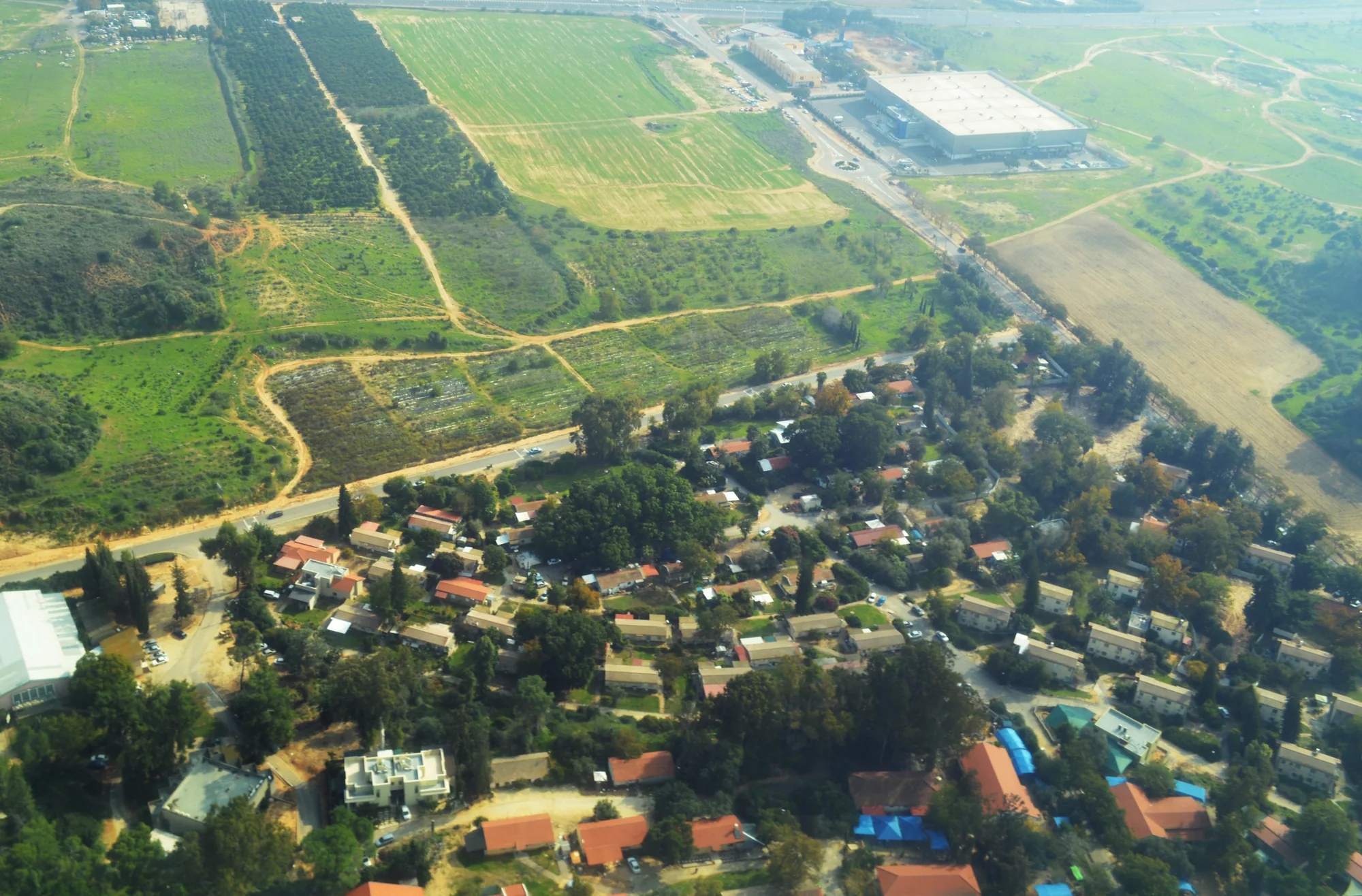
The sectors of the kibbutz. Giv'at Brenner has no neighbourhoods in the urban sense: life is organised around sectors that any visitor quickly recognises. The kibbutz centre brings together the communal dining hall, the secretariat, the Enzo Sereni cultural centre and the shared services — the heart of social life. The members' residential areas stretch beneath the trees, detached houses and low-rise blocks surrounded by gardens, with no fences and no through traffic. The agricultural sector and the orchards occupy the kibbutz lands: field crops, avocado trees, the nursery and the dairy farm, still a visible part of the local economy. The craft and industrial zone groups the historic workshops and factories — furniture, metalwork, canned food — witnesses to the kibbutz's entrepreneurial spirit. Finally, the recent extensions host new housing for members and young families, a sign that the community keeps growing.
Buying in Giv'at Brenner: what to understand. A kibbutz is not a conventional property market. Giv'at Brenner is a 'renewing' kibbutz (mitkhadesh): homes are allocated to members of the community, and becoming a member involves an admission process decided by the kibbutz — you do not buy a house there as you would buy a flat in town. That is why this page is a guide and not a catalogue: IsraelStart lists no new developments in the kibbutz, and most buying demand falls on the neighbouring cities, Rehovot, Gedera and Yavne, where new and resale supply is plentiful. The IsraelStart team supports buyers who want to live close to the kibbutz — for its setting, its schools or its community — by targeting properties in Rehovot and its surroundings, and also tracks resale opportunities that may appear around Giv'at Brenner.
The steps of a purchase around Giv'at Brenner. As everywhere in Israel, the process goes through a specialist lawyer: verifying the title deed at the Tabu, signing a contract overseen by the lawyer, and paying the purchase tax, mas rechisha, whose amount depends on the price of the property and the status of the buyer — the IsraelStart legal guide and the tax and fees simulator explain the calculation, with no fixed schedule quoted, as the tax counsel's arbitration is still pending. Financing goes through the mashkanta, the Israeli mortgage, which the financing simulator helps estimate, and the budget-by-city simulator helps compare Rehovot, Gedera and Yavne against your budget. For a first purchase from abroad, the 2026 buying guide and the page dedicated to aliyah complete this guide, and IsraelStart's personalised search targets the properties that truly match your project, in the kibbutz or, most often, all around it.
- A living community: Nearly a century of collective history, a cultural centre, festivals and a dense social life: the kibbutz is a village where people know each other.
- Nature in the coastal plain: Orchards, fields, nursery and tree-lined lanes: a green lung two minutes from Rehovot.
- Rehovot two kilometres away: Jobs, study, station, shops and hospital: everything a city offers, without living in it.
- An ideal setting for children: Regional school, gardens, quiet streets and outdoor life: the kibbutz is designed for families.
- A pioneering history: Founded in 1928 by Enzo Sereni and pioneers from Europe, named after the writer Brenner: the country's history can be read in its lanes.
Key advantages
- Kibbutz life, two kilometres from Rehovot: Greenery, shaded lanes, a communal dining hall and community life, with all the services of a city of 155,000 people minutes away.
- One of the largest kibbutzim in Israel: Founded in 1928, 2,518 residents in 2024: a solid, long-established community, with a history, institutions and a diversified economy.
- Jobs and study within reach: The Weizmann Institute and Rehovot science park, Rehovot station to Tel Aviv and Jerusalem, business areas in Gedera and Yavne minutes away.
- Respected schools: The Giv'at Brenner regional school serves the regional council's communities, and Rehovot's schools complete the offer, from kindergarten to high school.
- A green, family-friendly setting: Orchards, nursery, gardens and traffic-free streets: an environment appreciated by families with children and by those seeking calm.
Infrastructure & Transport
- Routes 40 and 412: The kibbutz is served by the coastal plain roads: Route 40 north and south, Route 412 to Rehovot and Gedera. Tel Aviv is about 25 minutes away by car.
- Rehovot station: Rehovot station, a few minutes away by car, reaches Tel Aviv in about twenty minutes and Jerusalem in about forty, via Lod.
- Buses to Rehovot and the centre: Bus lines to Rehovot, Gedera, Yavne and Tel Aviv. A car remains the most practical option for everyday trips.
- Healthcare and shopping in Rehovot: Kaplan Hospital in Rehovot minutes away, shopping centres and markets in Rehovot, neighbourhood shops in the nearby communities.
Investment profile
- No conventional rental investment in the kibbutz: Kibbutz homes are allocated to members: there is no free rental market in Giv'at Brenner. Investment plays out in Rehovot, Gedera and Yavne, all around it.
- Strong demand all around: Rehovot, with the Weizmann Institute and its skilled jobs, attracts researchers, students and families: rental demand there is sustained, and the kibbutz's surroundings benefit.
- Typical tenants in the area: Researchers and students in Rehovot, families working in the science park or in Tel Aviv, young couples seeking the calm of the coastal plain.
Neighborhoods of Giv'at Brenner
Kibbutz centre
Members' residential areas
Agricultural sector and orchards
Craft and industrial zone
Recent extensions
New build or resale in Giv'at Brenner
In Giv'at Brenner, you can compare the new developments listed in our catalogue or entrust us with the search for an existing property. The choice depends on your timeline, overall budget and target neighbourhood.
For resale, we define a brief with you — neighbourhood, number of rooms, mamad, lift, parking, outdoor space — then consult several sources and present an explained selection, with trade-offs and points to confirm.
Search in Giv'at Brenner Buying resale property: the guideFrequently asked questions about Giv'at Brenner
Can you buy a house in Giv'at Brenner?
Not as in a town: Giv'at Brenner is a renewing kibbutz, and homes are allocated to members of the community after an admission process decided by the kibbutz. There is no free market of houses for sale in the kibbutz, and no new development listed by IsraelStart (October 2026). Most buyers drawn to the setting turn to Rehovot, Gedera and Yavne, minutes away.
How do you become a member of the kibbutz?
Through an admission process specific to each kibbutz: meeting the community, a trial period and a decision by the kibbutz's bodies. Conditions vary from one kibbutz to another and change over time: ask the Giv'at Brenner secretariat directly before any plan.
Are there new developments in Giv'at Brenner?
No: IsraelStart lists no new developments in the kibbutz. New supply is found in Rehovot, Gedera and Yavne, which personalised search lets you compare by budget.
Why buy around the kibbutz rather than in it?
To enjoy the same setting — greenery, calm, schools, proximity to Rehovot — with a conventional title deed and a free market. Rehovot also offers the station, the Weizmann Institute and a much wider choice of new and resale properties.
How long does it take to reach Tel Aviv from Giv'at Brenner?
About 25 minutes by car to central Tel Aviv, and about twenty minutes by train from Rehovot station. Jerusalem is about forty minutes by train via Lod, and Ben Gurion Airport about half an hour away.
Similar cities
Discover other nearby cities or in the same price range.