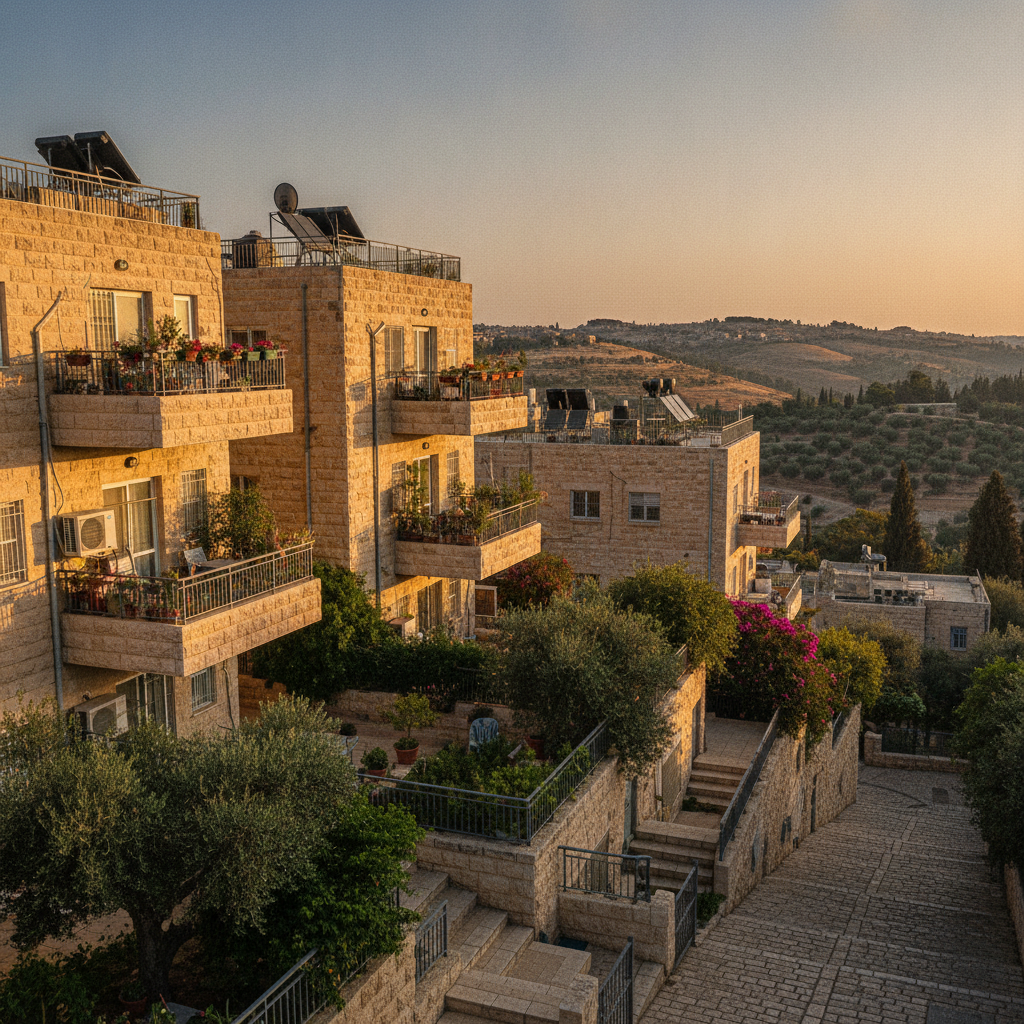
Jerusalem and Beit Shemesh in 2026: stable prices on one side, +3% on the other
In the first half of 2026, Jerusalem posts an almost unchanged average price of ₪3.089 million. Its more affordable neighbor Beit Shemesh is up 3%. Two linked markets, two dynamics.
The real estate prices in Jerusalem have remained virtually unchanged over the past year. In the first half of 2026, the average transaction price reached around 3.089 million shekels, compared to 3.085 million a year earlier. Meanwhile, Beit Shemesh, about thirty kilometers away, saw an increase of 3%, reaching approximately 2.455 million.
Two cities connected by population flows, yet with distinct dynamics. For Israeli families as well as buyers from abroad, who are often attached to the region, the comparison is worth considering.
Jerusalem: Stability
With an average price of 3.089M ₪, Jerusalem maintains the third place among the 18 largest cities, behind Tel Aviv and Herzliya, and just ahead of Ramat Gan.
This stability is explained by the very nature of the Jerusalem market:
- Structural demand: large families, students, civil servants, religious and academic institutions;
- Limited supply due to topography, urban planning regulations, and the requirement for Jerusalem stone facades;
- Very different markets from one neighborhood to another, from the historic center to developing peripheral districts.
The municipal average therefore hides contrasting trends. For an in-depth look at each neighborhood, check out our Jerusalem real estate guide.
Beit Shemesh: the rising alternative
Beit Shemesh has increased from around 2.384M ₪ to 2.455M ₪, a rise of 3%, or about 71,000 ₪. This city is experiencing strong population growth and has seen many new neighborhoods develop in recent years.
It particularly attracts:
- Families looking for more space than in Jerusalem for a similar budget;
- Long-established English- and French-speaking communities;
- Buyers for whom community life and proximity to schools matter as much as commuting distance.
The Comparison
| Indicator | Jerusalem | Beit Shemesh |
|---|---|---|
| Average Price H1 2025 | 3.085 M ₪ | 2.384 M ₪ |
| Average Price H1 2026 | 3.089 M ₪ | 2.455 M ₪ |
| Change | stable | +3.0% |
| Gap with national average | +29% | +3% |
The gap between the two cities is narrowing slightly, but Beit Shemesh remains about 20% cheaper than Jerusalem in terms of average price.
Who Each City is Suitable For
Jerusalem
- You work or study in Jerusalem, or want to be close to institutions;
- You are looking for long-term asset value in a city with sustained demand;
- You are preparing to move and want a pied-à-terre in the meantime, or a future main residence.
Beit Shemesh
- You have a large family and prioritize space;
- You are willing to accept a longer commute to Jerusalem or the center;
- Community life is a key factor for you.
What Stability Really Means
A stable average does not mean that every neighborhood is stagnant. In Jerusalem, some highly sought-after areas may continue to rise while others, where new supply is developing, stabilize or decline slightly. The municipal average smooths out these movements. For a buyer, this means you need to think at the neighborhood or even street level, and compare the price per sqm of truly comparable projects.
This stability also provides a concrete advantage: it reduces time pressure. You can take the time to visit, compare developers, and negotiate payment terms without worrying that prices will soar from one quarter to the next.
Buying in Jerusalem or Beit Shemesh: Method
Take Advantage of Market Stability
A stable market means there’s no need to rush. This is the time to compare different developments, visit properties, check the quality of developers, and negotiate terms.
Understand Your Tax Situation
The purchase tax (Mas Rechisha) depends greatly on your status: single residence in Israel, foreign resident, or investor. The tax scale has changed in recent years and must be checked according to your profile. Our Mas Rechisha guide explains the rules, and the taxes and fees calculator gives you an initial estimate. Reminder: the 18% VAT is included in the price of new properties, and closing costs typically range from 10 to 13%.
Secure the Contract
In Jerusalem, some plots are subject to special land regimes (long-term leases, institutional lands). A lawyer must check the land status, registration, and the bank guarantee.
Validate the Technical Project
An architect reviews the plans, orientation, insulation, and compliance of the features. Along with the lawyer and mortgage broker, they form your essential team.
IsraelStart supports buyers from abroad as well as Israelis already in Israel, in their language, across more than 300 new projects throughout Israel. A personalized, no-obligation assessment helps you decide between Jerusalem, Beit Shemesh, and other options.
Sources and Method
- Ynet analysis of Central Bureau of Statistics (CBS) data, published September 15, 2026.
- Israel Central Bureau of Statistics (CBS) — average transaction prices by city and by number of rooms.
- Bank of Israel — real estate credit volumes (August 2026 data).
The prices for the first half of the year are an arithmetic average of the first two quarters, compared to the same calculation for 2025. The number of transactions is not weighted: a small volume of sales can significantly affect a city's average. Indicative figures, to be cross-checked project by project before making any decisions.
Need personalized support?
An IsraelStart expert will call you within 24h with a personalized analysis of your project.